Nahaufnahme eines Frauenkopfes von der Seite und Schallwellen

Acoustic calculation

Good room acoustics are essential, because noise and unfavorable sound conditions demonstrably impair performance and well-being. They reduce concentration, increase stress, and raise the error rate; in the long run, they can even be detrimental to health. Targeted acoustic planning counteracts this: it reduces disturbances, promotes intelligibility, and creates a quiet, productive atmosphere.

Systematic Room Acoustics – Precise Acoustic Calculations for Healthy, Productive Work Environments

Why acoustics is more than just sound insulation

Good room acoustics are not a luxury – they are an essential factor for well-being, concentration, and motivation. Noise and poor acoustics demonstrably lead to stress, increased error rates, and long-term health problems. Conversely, acoustically optimized rooms create an atmosphere in which people can feel comfortable and work productively. Healthy acoustics = healthy employees = healthy business success.

Why do the rooms echo?

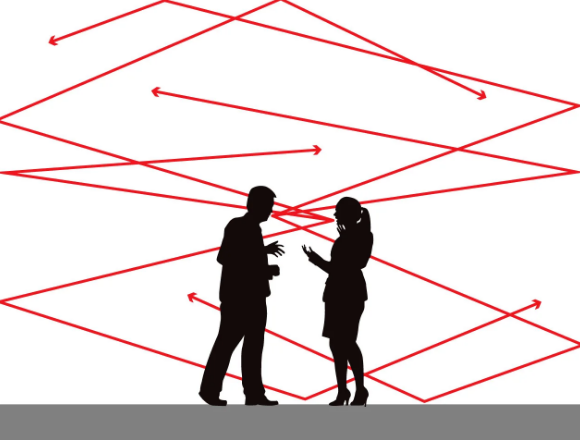
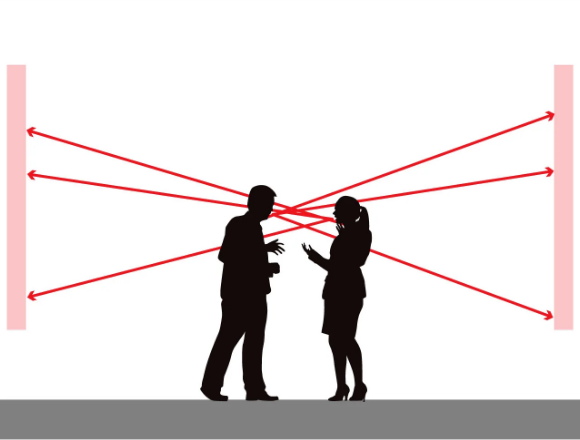
The cause of poor room acoustics lies in smooth surfaces: sound waves, for example from speaking, working, walking, and other ambient noises, are reflected by these so-called sound-hard surfaces. The more of these there are, the more it echoes. Are there large window fronts, glass walls, wooden and stone floors, smooth walls, ceilings, or tabletops in your rooms? Stand in the middle of the room and clap your hands. What you hear after clapping is called the reverberation time. And the longer this is, the more unpleasant it is for our ears, because the sound passes by them several times from different directions.

Here you can clearly see how the sound generated is repeatedly reflected by smooth surfaces, thereby disturbing the conversation between the two people.

Through appropriate acoustic pictures (absorbers), sound is absorbed and no longer interferes with conversations in the room. We offer acoustic calculations to determine the required number.

The Impact of Acoustics on People

  • Concentration and Focus: In noise-reduced environments, the ability to concentrate increases significantly.
  • Well-being: Pleasant acoustics have a calming effect, reduce stress hormones, and improve the subjective perception of space.
  • Health: Constant noise promotes headaches, tension, and even burnout.
  • Motivation & Identification: Those who feel comfortable at work are more motivated – and remain loyal to the company longer.

A motivated team is the engine for an efficient and successful company. Good acoustics make a measurable contribution to this – also through reduced absenteeism.

What constitutes good room acoustics?

Good room acoustics means more than just "less noise." It is based on:

  • Optimal reverberation time: The sound energy in the room is specifically reduced.
  • Clear speech intelligibility: Essential, especially in meeting or training rooms.
  • Reduced disruptive noise: Background noises are minimized so that concentration can be maintained.
  • Pleasant sound atmosphere: The room sounds "right" – neither echoey nor muffled.

Primex Acoustic Calculation – Precise, transparent, effective

Every room is different – that's why good acoustics always start with a thorough analysis. Our acoustic calculation provides you with:

  • Individual room analysis based on use, geometry, materials, and volume
  • Calculation of the optimal reverberation time according to DIN 18041
  • Concrete recommendations for suitable acoustic elements (surface area required, positioning, absorber classes)
  • Transparent documentation for sharing with planners, clients, or internal decision-makers

Our Solution: Highly Effective Acoustic Elements from Primex

We offer you a versatile portfolio of acoustically effective design elements that combine functionality with design:

  • Acoustic pictures, ceiling sails & room dividers – sound-absorbing, individually printable, and flexibly deployable
  • Stretching frames with acoustic fleece – discreet or eye-catching, printed with your desired graphic
  • New: Acoustic light wall & acoustic light ceiling – the perfect combination of lighting atmosphere, acoustic optimization, and visual design
  • Backlit acoustic elements – acoustically effective and atmospherically staged at the same time
  • Custom-made solutions – tailored to your architecture, corporate design, and functional requirements

Our solutions not only create calm but also visual identity – for spaces that resonate and impress.

Conclusion: Invest in Quiet – Gain Performance

Room acoustics are measurable, plannable, and highly effective. With Primex, you don't just get off-the-shelf solutions, but individually calculated measures for more well-being, productivity, and business success.

Calculate acoustics now

Let's rethink the sound of your rooms together.Schedule a consultation or send us your room data – we will get back to you with a customized proposal.

Telephone consultation

We offer a free, no-obligation initial telephone consultation. You're not sure what the right thing is yet? No problem, we'll find a suitable solution for you. Our experts have already implemented many projects and can help you further.

Online Consultation

Online consultations via email or even video meetings are no problem. Our experts look forward to every new project. It's not important to already have a concept or a precise idea. Our experience shows that concepts can always change.

On-site consulting

Would you like to get to know us personally? Great, we look forward to meeting you. We offer consultations at our premises or directly at your location. It is, of course, a great advantage for our experts to see the premises live in order to create a concept. It is also possible to take reverberation measurements directly on site.

How to start an acoustics project correctly?

It is recommended to:

  1. Send room data and/or floor plan
  2. Attach photos or context of use
  3. Define objectives (e.g., meeting, retreat zone)
  4. Initial consultation & proposal based on sound calculations

Room acoustics is not a luxury – but the basis for health, efficiency, and design quality

Good room acoustics can be planned and measured. It increases concentration and general well-being, significantly improves speech intelligibility, and helps reduce downtime and sustainably increase motivation.

FAQ - Acoustic Calculation

Why is room acoustics even important?

Good room acoustics are of central importance, as noise and acoustically unfavorable rooms have proven negative effects. They lead to lower concentration, increased stress levels, and a higher susceptibility to errors. In the long term, they can even pose a health burden. Thoughtful acoustic design achieves the exact opposite: it creates peace, clarity, and a pleasant communication atmosphere. It increases productivity by reducing distracting noises, lowers stress and noise perception, and significantly improves speech intelligibility, especially in meeting rooms. Furthermore, it enhances overall well-being in daily life and contributes sustainably to a better quality of work.

What are the benefits of optimized room acoustics?
  • Increased productivity through reduced noise interference
  • Less stress and noise sensitivity
  • Improved speech intelligibility in meeting rooms
  • Greater well-being in everyday life
  • Sustainable improvement in work quality
What is reverberation time?

Reverberation time describes how long a sound event lingers in a room. An excessively long reverberation time makes speech unintelligible, while overly short times make the room sound "dry." The optimal reverberation time depends on room size and usage.

Which standard regulates the requirements for room acoustics?

DIN 18041 specifies the acoustic requirements for rooms, particularly concerning reverberation time and speech intelligibility – adapted to room usage (e.g., office, school, conference).

How does an acoustic calculation work?

Typical procedure:

  1. Analysis of room volume, geometry, and materials
  2. Definition of target values according to standards
  3. Calculation of the necessary absorption coefficient
  4. Recommendation of suitable acoustic elements (type, area, position)
  5. Documentation for handover to planners or decision-makers
What types of acoustic elements are there?

Our sound absorbers – acoustic elements are distinguished with the highest sound absorption class A and thus combine function and design.

Wall panels/acoustic picture: A sound absorber picture has a sound-absorbing effect and improves room acoustics. Reverberation is reduced, noise levels are lowered, and speech intelligibility is improved. Both in the work environment and during leisure activities, for example in restaurants, it becomes easier to converse, relax, and concentrate.

Ceiling baffles: The sound-absorbing ceiling baffles improve room acoustics and lower the noise level. They have a sound-absorbing effect and are an optical highlight. The ceiling is the ideal place for acoustic elements, as they can unfold their effect particularly well here. Sound absorption increases concentration and promotes well-being.

Room dividers: With our sound absorber walls, you can visually and acoustically separate areas from each other. For example, create quiet zones and workplaces in the same room.

Acoustic ceilings & luminous ceilings with acoustic function: Acoustic ceilings and luminous ceilings with integrated sound absorption combine effective noise reduction with modern lighting design. They sustainably improve room acoustics, reduce reverberation, and create a calm and high-quality room atmosphere through uniform, pleasant lighting. This increases both concentration and performance as well as well-being in work, common, and public areas.

Can acoustic elements also be illuminated?

Yes – modern solutions combine light and acoustics:

  • Acoustic light walls
  • Backlit acoustic panels
  • Acoustic ceilings with dimmable LED technology

This creates multifunctional room elements with high design quality.

How much area needs to be acoustically treated?

This depends on:

  • Room size & usage
  • Surface materials (glass, concrete = "hard")
  • Target reverberation time according to DIN


Generally, placing just one small element is not enough – effective acoustics are created by systematically distributed absorber surfaces.

Can acoustic elements be customized?

Yes – technically and creatively:

  • Individual formats and designs (e.g. CI-compliant graphics)
  • Frame colors according to RAL
  • Free forms, curves, room heights, etc.
  • Integration into lighting, branding or color concepts
How does acoustics affect health and motivation?
  • Reduces cortisol levels & noise stress
  • Promotes recovery in break areas
  • Enables clear communication within the team
  • Ensures well-being and identification with the workplace
What is an acoustic fleece and how does it work?
  • Acoustic fleece is a highly absorbent material that absorbs sound waves and converts them into heat.
  • It is lightweight, pollutant-free and recyclable
  • It is invisibly integrated into textile tension frames
  • It is available in various thicknesses & absorber classes
Are the products fire-tested?

Professional acoustic elements meet common safety standards:

  • Textiles usually B1 (flame retardant) or A2
  • Material certificates available upon request
  • Suitable for public buildings and sensitive areas of application